
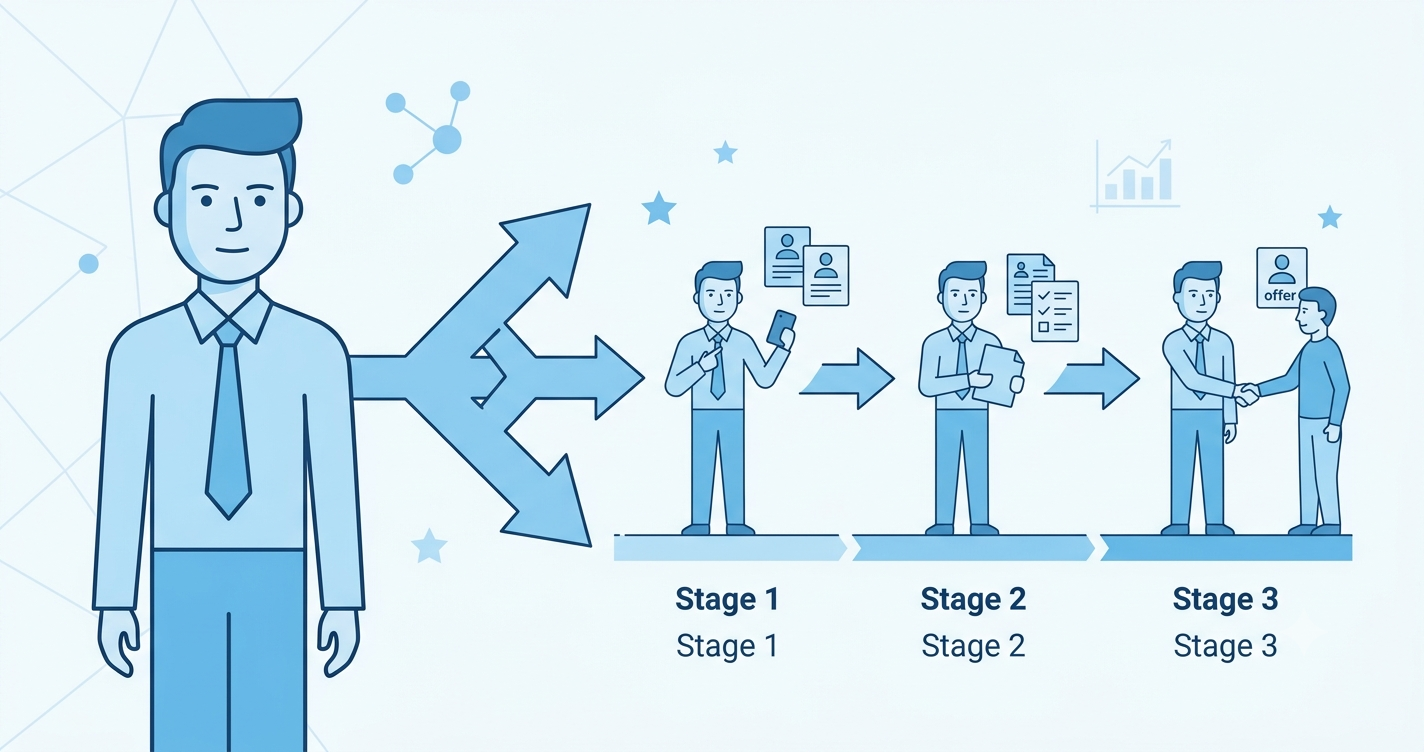
How to Divide Sourcing, Screening, and Closing Across a Small Team
Rakesh · October 2, 2026 · 15 min read
At some point, every growing recruiting team hits the same wall: one or two people are doing everything — finding candidates, screening them, running interviews, chasing hiring managers, closing offers — and it's starting to show. Candidates fall through cracks. Sourcing gets rushed because closing an active offer feels more urgent. The person who's great at building relationships with passive candidates is stuck doing paperwork instead. This is usually the exact moment a team needs to decide whether, and how, to start dividing the work — not by adding headcount blindly, but by deliberately splitting sourcing, screening, and closing into distinct, well-defined responsibilities.
This article lays out a practical framework for making that decision on a small team specifically, without over-engineering a structure built for a company five times your size.
Why This Decision Matters More Than It Seems
The tasks genuinely require different skills and mindsets. Sourcing is fundamentally a research and outreach discipline — market mapping, identifying where relevant talent actually is, crafting messaging that gets a response from someone who wasn't looking for a job. Closing is a relationship and negotiation discipline — building trust, reading hesitation, managing competing priorities at the finish line. Industry practitioners consistently observe that the same person being excellent at both is the exception, not the rule, and that trying to force one person to be equally strong at both disciplines often means neither gets done as well as it could be.
Specialization has a measurable payoff, at least on the sourcing side. Gem's research has found that sourced (outbound) candidates are roughly 5 times more likely to be hired than inbound applicants — a substantial performance gap that makes a strong case for giving proactive sourcing genuine, protected attention rather than treating it as something squeezed in between other responsibilities.
But specialization isn't free, and small teams can genuinely overbuild it. More roles create more handoffs, and every handoff is a place candidates or information can be dropped if it isn't designed deliberately. Industry observation across recruiting operations consistently notes that adding specialized roles without fixing the underlying workflow "just creates more drag" — meaning the decision to specialize needs a clear trigger, not just a sense that the team feels busy.
Team size guidance varies, but a consistent "small but mighty" pattern emerges across sources. For companies in the roughly 50-200 employee range needing a dedicated function, a commonly recommended structure is a small team of 4-5 people: 2-3 full-cycle or specialized recruiters, one coordinator, and one sourcer — a deliberately lean model rather than the fully divided, many-role structure appropriate for much larger organizations.
The reframe worth internalizing: The question isn't "should we specialize?" in the abstract — full-cycle recruiting is genuinely the right model at small scale, and premature specialization can add coordination overhead a small team doesn't yet need. The real question is which specific trigger — volume, role difficulty, or a clear skill mismatch on the team — actually justifies splitting a particular function off.
The Three Core Functions, Defined
Sourcing owns the top of the funnel: identifying where relevant candidates are, building outreach lists, running proactive outreach campaigns, and qualifying initial interest before handing a warm lead further into the process. A sourcer typically doesn't run interviews or close offers.
Screening (often bundled with the broader "recruiter" role on a small team) owns the middle: evaluating candidates against role requirements, running initial screening conversations, coordinating with hiring managers on calibration, and managing the interview loop.
Closing owns the final stage: managing offer negotiation, addressing a candidate's remaining hesitations, and getting a signed acceptance — a discipline that draws more on relationship management and negotiation than on evaluation or research.
On a small team, these three functions are frequently combined into a single "full-cycle recruiter" role, and that's often the right starting point. The question this article addresses is when and how to start splitting them apart.
A Practical Framework: When to Specialize
Trigger 1 — Volume in a Specific Function Exceeds What One Person Can Sustain
A commonly cited practical threshold: consider a dedicated sourcer once a single role type or department is generating more than 5-6 simultaneous active openings, or once a recruiter is spending more than roughly 60% of their time on top-of-funnel sourcing work specifically — at that point, sourcing has effectively become a full-time job hiding inside a full-cycle role.
Trigger 2 — A Clear, Persistent Skill Mismatch Emerges
If it's become obvious over time that certain people on the team are consistently strong closers but weak sourcers (or vice versa), and this pattern has held across multiple hires rather than being a one-off, that's a signal the team may perform better by formally dividing the work along those natural strengths rather than asking everyone to be equally competent at every stage.
Trigger 3 — A Specific Stage Is Consistently the Bottleneck
If feedback consistently points to one function — candidates aren't being found fast enough, screened thoroughly enough, or closed effectively enough — dedicating focused ownership to that specific stage is a more targeted fix than adding general headcount and hoping the bottleneck resolves itself.
Trigger 4 — Role Complexity or Seniority Increases Significantly
Sourcing for a hard-to-fill, specialized, or senior-level role typically requires a different depth of market knowledge and passive-candidate engagement than sourcing for a higher-volume, more standardized role — as complexity rises, the case for a dedicated sourcer with genuine market expertise strengthens.
If none of these triggers are clearly present yet, a small team is very likely still better served by full-cycle recruiters handling sourcing, screening, and closing together — adding specialized roles prematurely tends to introduce coordination overhead without a clear corresponding benefit.
A Practical Framework: How to Divide the Work Once You Do Specialize
Step 1 — Decide Ownership Before Assigning Titles
Before creating new role labels, answer the more fundamental question directly: does one person run a requisition end-to-end, or does a sourcer hand off to a separate closer partway through? Getting this decision right matters more than what anyone's title ends up being.
Step 2 — Design the Handoff Explicitly
Specify exactly what has to be true before a candidate moves from sourced to screened, and from screened to interview-ready — and specify who's accountable if a candidate stalls at a given stage. Undefined handoffs are where specialization most commonly introduces new drag rather than removing old drag.
Step 3 — Establish Clear Decision Rights for Competing Priorities
When two departments both want the same senior recruiter's time in the same week, decide in advance who arbitrates that conflict — waiting until the conflict happens in real time tends to produce ad hoc, inconsistent resolutions that erode trust in the process.
Step 4 — Start With Labeling Functions, Not Necessarily New Headcount
Even before hiring a dedicated sourcer or closer, a useful early step is explicitly naming the distinct functions a full-cycle recruiter is currently juggling — sourcing, screening, closing — as separate, tracked responsibilities. This makes it much easier to identify exactly which function needs dedicated headcount later, based on where time and effort are actually concentrated.
Step 5 — Keep the Team as Lean as the Workload Genuinely Requires
The goal isn't building the most specialized team possible — it's building the smallest team that can run a consistent, reliable hiring process at your current volume. Over-specializing a small team, with more roles than the workload justifies, tends to create coordination costs that outweigh the specialization benefit.
A Practical Checklist: Deciding Whether and How to Specialize
Check whether any single function (sourcing, screening, closing) is consuming a disproportionate share of a recruiter's time relative to the others
Confirm whether a persistent skill mismatch has appeared across multiple hires, not just one difficult search
Identify whether one specific stage is consistently flagged as the bottleneck in feedback
Before adding headcount, explicitly label and track the distinct functions your current team is already juggling
If you do specialize, document the handoff criteria and ownership explicitly, rather than leaving it implicit
Establish decision rights for competing priorities before they cause friction in practice
Global Perspective: Team Structure Considerations by Region
🇦🇺 Australia
With vacancy fill rates declining to roughly 68.2% nationally (Jobs and Skills Australia, March 2026) and skills shortages concentrated in specific trades and technical occupations, a small Australian team may find dedicated sourcing pays off earlier than the general volume-based triggers above suggest, given how much deeper proactive market research often needs to go in a genuinely thin, specialized talent pool.
🇺🇸 United States
The clearest available team-structure guidance and benchmarking (ADP Research on recruiter-to-employee ratios, Gem's sourcing performance data) is largely U.S.-anchored, though the underlying principles — trigger-based specialization, explicit handoff design — generalize well across markets.
🇬🇧 United Kingdom
CIPD's sector-level shortage data (healthcare, social care, education) suggests UK teams hiring heavily into these specific sectors may benefit from earlier sourcing specialization than a generic volume threshold would indicate, given the documented depth of shortage in these fields specifically.
🇪🇺 Europe (broad view)
Labor market regulation and typical hiring process length vary meaningfully by country, meaning a multinational small team may need slightly different specialization thresholds by country rather than a single blended standard, echoing the broader principle that structure should follow local hiring reality.
🇮🇳 India
With 82% of Indian employers reporting difficulty filling roles (ManpowerGroup's 2026 Talent Shortage Survey), concentrated heavily in AI-related technical skills, small Indian teams hiring for these specific, scarce skill categories may benefit from earlier sourcing specialization, since Gem's finding that sourced candidates convert roughly 5 times better than inbound applicants is likely to matter even more in a market where qualified candidates rarely apply proactively on their own.
What Most Articles Get Wrong
Most "recruiting team structure" content is written for organizations already at meaningful scale — listing six or eight distinct roles (sourcer, recruiter, coordinator, recruiting operations, employer brand manager, TA leader) as if every growing team needs all of them simultaneously. For a genuinely small team, this overstates what's actually needed and skips the more important decision: which specific trigger justifies specializing a given function, and in what order. A small team following an enterprise org chart prematurely often ends up with more coordination overhead than the workload actually requires.
The second common gap: most guides jump straight to listing job titles without addressing the more fundamental decisions — ownership, handoffs, and decision rights — that actually determine whether specialization improves or worsens the team's performance. Titles without those decisions clearly made in advance tend to reproduce the same confusion in a slightly different shape.
Common Mistakes Companies Make
❌ Specializing roles before any clear volume, skill-mismatch, or bottleneck trigger has actually appeared
❌ Adding new titles without deciding ownership, handoff criteria, or decision rights first
❌ Assuming every person on a full-cycle team is equally strong at sourcing, screening, and closing
❌ Following a large-organization org chart at a scale where it introduces unnecessary coordination overhead
❌ Leaving handoffs implicit, so nobody is clearly accountable when a candidate stalls between stages
❌ Treating "add more roles" as the default fix for a bottleneck, rather than first identifying which specific function is actually underperforming
Checklist: Is Your Team Structure Actually Right for Your Current Stage?
You can name a specific trigger (volume, skill mismatch, or bottleneck) behind any specialization decision you've made
Ownership for each requisition is clearly defined — full-cycle, or a specific handoff chain
Handoff criteria between stages are documented, not left to informal judgment
Decision rights for competing priorities are established before conflicts arise, not resolved ad hoc each time
Your team's structure matches your current hiring volume and complexity, not a larger organization's org chart
You've identified which specific function (sourcing, screening, or closing) would benefit most from dedicated focus, if any
Where Tools Fit — and Where They Don't
Given that specialization decisions depend heavily on knowing where time is actually going, this is a stage where the right tooling provides genuine diagnostic support: tracking time and outcomes by function (sourcing, screening, closing) even within a full-cycle role, so a team can identify exactly which function is consuming disproportionate effort before deciding to specialize. This is exactly the layer FastHire's workflow and reporting tools are designed to support — surfacing function-level data that would otherwise require manual, ad hoc tracking to uncover.
What no tool can decide on its own is which specific structural model — full-cycle, pod-based, or specialized — fits your team's particular stage, culture, and hiring complexity. That requires genuine judgment about ownership, handoffs, and decision rights, informed by data but ultimately a leadership decision about how the team should actually work together.
Key Takeaways
Full-cycle recruiting, where one person handles sourcing, screening, and closing, is genuinely the right model for most small teams — the goal isn't maximum specialization, it's the smallest structure that reliably supports current volume.
Sourced, outbound candidates convert to hires at roughly 5 times the rate of inbound applicants, according to Gem's research, making proactive sourcing a strong early candidate for dedicated focus once volume justifies it.
Clear triggers — sustained high volume in one function, a persistent skill mismatch, a consistently identified bottleneck, or rising role complexity — should drive specialization decisions, not a general sense that the team feels busy.
A commonly recommended "small but mighty" structure for a growing small team is roughly 4-5 people: 2-3 recruiters, one coordinator, and one sourcer.
Deciding ownership, designing explicit handoffs, and establishing decision rights matter more than choosing job titles — specialization without these decisions made explicitly tends to just relocate the original confusion.
Even before adding dedicated headcount, explicitly labeling and tracking the distinct functions a full-cycle team is juggling makes the eventual specialization decision far more evidence-based.