
Managing Multiple Open Roles Without Losing Track of Candidate Status
Rakesh · October 6, 2026 · 16 min read
Every recruiter juggling several open roles at once has had this moment: a candidate reaches back out, and there's a brief, uncomfortable pause while you try to remember which role they were actually in the running for, what stage they were at, and whether anyone was supposed to follow up with them last week. Nothing went catastrophically wrong — but something quietly slipped, and the candidate noticed. Multiply that moment across a dozen-plus open requisitions, and it stops being an occasional lapse and becomes a structural risk to both candidate experience and hiring outcomes.
This article lays out why candidate status specifically gets lost when managing multiple concurrent roles, and a practical system for maintaining real visibility without requiring superhuman memory or constant manual double-checking.
The Core Problem: The "Stagnant Middle"
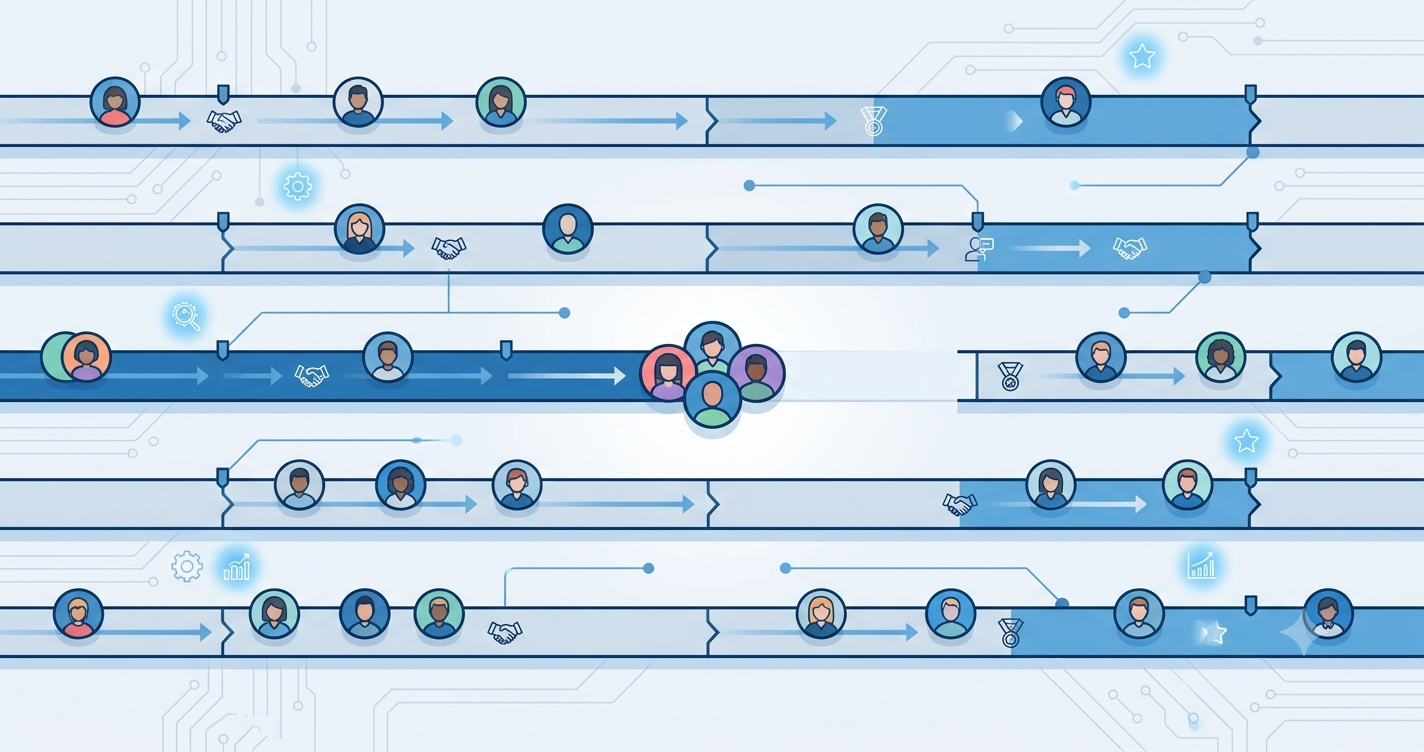
Staffing Industry Analysts (SIA), a respected research firm covering the staffing and recruiting industry, has identified a specific, well-recognized pattern worth naming directly: most recruiting pipelines contain a "stagnant middle" — a group of candidates who passed initial screening and are technically still "in process," but have no scheduled next step, no recent activity, and no clear owner actively moving them forward. They're neither being advanced nor rejected; they're simply sitting, often for far longer than anyone realizes, until either the candidate loses patience and disengages, or a recruiter stumbles across them during an unrelated review.
This pattern is precisely what tends to worsen as requisition load increases. A recruiter managing one or two open roles can hold pipeline status largely in working memory. A recruiter managing the industry-typical 14 concurrent open requisitions — a caseload that's grown 56% over the past three years, per Gem's Recruiting Benchmarks Report — simply cannot reliably do the same. The "stagnant middle" isn't a sign of a careless recruiter; it's the predictable, structural result of pipeline volume outgrowing working memory as the primary tracking method.
The reframe worth internalizing: If a candidate falls through the cracks while you're managing multiple open roles, the more useful diagnostic question usually isn't "how did I forget about them" — it's "why did the system rely on me remembering in the first place." Memory-based tracking works at low volume and breaks down predictably at higher volume; the fix is structural, not a matter of trying harder to remember.
Why Candidate Status Specifically Gets Lost Across Multiple Roles
1. Context-Switching Between Requisitions Erodes Recall
Moving between a dozen-plus open roles throughout a single day means constantly re-loading context — who's in this pipeline, what stage are they at, what was the last thing that happened. Each switch carries a real cognitive cost, and details from a role you haven't touched in three days are the first things to fade.
2. Status Fields Lag Behind Actual Reality
An ATS status field only reflects reality if someone manually updates it the moment something changes. Under time pressure, updating the system often becomes the last priority after the actual candidate interaction — leaving the recorded status stale, sometimes for days, even when real progress (or a real problem) has already occurred.
3. Candidates in Multiple Pipelines Simultaneously Create Duplicate Risk
A strong candidate might reasonably be considered for more than one open role at once. Without a clear, shared view of which roles a given candidate is already active in, it's easy for two different recruiters — or the same recruiter juggling too much — to unintentionally duplicate outreach, creating an awkward, credibility-damaging candidate experience.
4. "No News" Doesn't Trigger Any Alert by Default
A candidate with a scheduled next step who misses it is often noticed quickly. A candidate who was simply never given a next step in the first place tends to generate no alert at all — silence doesn't naturally flag itself the way a missed appointment does, which is exactly how candidates drift into the stagnant middle unnoticed.
5. Manual Pipeline Reviews Don't Scale With Volume
A recruiter can reasonably review a handful of active pipelines from memory or a quick scan. Reviewing a dozen-plus pipelines with genuine thoroughness, on a recurring basis, without a structured process is a task that gets deprioritized precisely when it's needed most — during the busiest, highest-volume periods.
A Practical Framework: Building Real Cross-Requisition Visibility
Step 1 — Give Every Candidate an Explicit, Owned Next Step
The single most important discipline: no candidate should exist in a pipeline without a specific, dated, owned next action attached to them. "Follow up" is not a next step; "call Thursday to confirm interview availability" is. A candidate without an explicit next step is, by definition, already drifting toward the stagnant middle.
Step 2 — Run a Structured Weekly Pipeline Review, Not Just Ad Hoc Checks
Set a recurring, non-negotiable time to review every active pipeline specifically for candidates with no scheduled next step or no recent activity — not just the roles that feel urgent that particular week. This is the direct, practical countermeasure to the stagnant-middle pattern SIA's research identifies.
Step 3 — Maintain a Single, Shared View of Candidates Across All Active Roles
Rather than treating each requisition's pipeline as an isolated list, maintain visibility into which candidates are active across multiple roles simultaneously — both to avoid duplicate outreach and to recognize when a candidate who wasn't right for one role might genuinely fit another that's just opened.
Step 4 — Build in Automatic Flags for Silence, Not Just Missed Appointments
Since silence doesn't naturally trigger attention the way a missed meeting does, deliberately configure status tracking to flag candidates who've had no activity or scheduled next step within a defined window (commonly 5-7 business days) — converting an invisible risk into a visible, actionable one.
Step 5 — Assign Clear Ownership When Multiple People Touch the Same Candidate
If a sourcer, a screening recruiter, and a closer might all interact with the same candidate at different stages (see the FastHire piece on dividing sourcing, screening, and closing across a small team), make explicit who owns overall status accuracy for that candidate at any given moment, rather than assuming it's "whoever last touched them."
Step 6 — Prioritize Review Attention by Requisition Tier, Not Evenly
Following the same logic as requisition triage discussed elsewhere in this cluster, review business-critical requisitions' pipelines more frequently and thoroughly than lower-priority backfill roles — spreading review attention evenly across every open role, regardless of priority, tends to under-serve the roles that matter most.
A Practical Checklist: Keeping Candidate Status Visible Across Multiple Roles
Every active candidate has an explicit, dated, owned next step — never a vague "follow up later"
A recurring, structured weekly pipeline review covers every open role, not just the ones that feel urgent
You maintain a shared, cross-requisition view of which candidates are active in more than one pipeline
Status tracking flags candidates with no activity or scheduled next step within a defined window automatically
Ownership for status accuracy is explicit when multiple team members touch the same candidate
Review frequency and depth scales with requisition priority, not spread evenly regardless of business impact
Global Perspective: Pipeline Visibility Challenges by Region
🇦🇺 Australia
With vacancy fill rates declining to roughly 68.2% nationally (Jobs and Skills Australia, March 2026) and skills shortages concentrated in specific occupations, losing a candidate to the stagnant middle carries an outsized cost in the Australian market, where a genuinely qualified replacement may simply not exist in the same numbers.
🇺🇸 United States
SIA's research on pipeline stagnation and Gem's benchmarking data on rising requisition loads are both largely U.S.-anchored, reflecting a market where recruiters are managing an increasingly high concurrent caseload that makes memory-based tracking especially unreliable.
🇬🇧 United Kingdom
CIPD data on persistent hard-to-fill vacancies in healthcare, social care, and education suggests UK recruiters in these specific sectors face a double cost from pipeline stagnation — an already thin qualified pool, compounded by any candidates lost simply to poor visibility rather than genuine unavailability.
🇪🇺 Europe (broad view)
Multi-country hiring processes common in several European organizations add an additional visibility challenge — candidates and requisitions spread across country-specific systems or teams can make a genuinely unified, cross-requisition view harder to maintain without deliberate coordination.
🇮🇳 India
With 82% of Indian employers reporting difficulty filling roles (ManpowerGroup's 2026 Talent Shortage Survey), particularly for scarce AI-related technical skills, losing a strong candidate to the stagnant middle is especially costly in the Indian market, where competing employers are likely pursuing the same narrow pool simultaneously.
What Most Articles Get Wrong
Most content on this topic defaults to "just use an ATS" as if adopting software alone solves the problem. It doesn't, on its own — an ATS only reflects reality as accurately as the people using it keep it updated, and SIA's research on the "stagnant middle" describes exactly this failure mode occurring inside organizations that already have ATS platforms in place. The real fix isn't the existence of a tracking tool; it's the discipline of giving every candidate an explicit next step and building in automatic flags for silence, which most generic ATS-adoption advice doesn't address directly.
The second common gap: most guides treat every open requisition and every candidate within it as equally deserving of review attention. In practice, review capacity is finite, and spreading it evenly regardless of business priority means the requisitions that matter most don't get proportionally more scrutiny — a mismatch worth correcting deliberately rather than leaving to whichever role happens to feel most urgent in a given week.
Common Mistakes Companies Make
❌ Relying on recruiter memory to track candidate status across a large number of concurrent open roles
❌ Leaving candidates with vague or no next step, rather than a specific, dated, owned action
❌ Running pipeline reviews only for roles that feel urgent that week, rather than systematically across all open requisitions
❌ Having no shared, cross-requisition view of candidates who might be active in more than one pipeline at once
❌ Assuming silence is harmless, when it's often the first, invisible sign a candidate is drifting into the stagnant middle
❌ Spreading review attention evenly across every requisition regardless of business priority
Checklist: Is Your Candidate Status Tracking Actually Reliable?
No candidate exists in an active pipeline without an explicit, owned next step
A structured, recurring pipeline review happens across every open role, not just the visibly urgent ones
You have a genuine, shared cross-requisition view of candidates active in multiple pipelines
Silence (no activity, no scheduled next step) triggers an automatic flag rather than relying on someone noticing
Ownership is explicit when a candidate is touched by more than one team member
Review depth and frequency scales with requisition priority, not applied evenly regardless of business impact
Where Tools Fit — and Where They Don't
Given that the core failure mode is memory-dependent tracking breaking down at volume, this is a stage where the right tooling provides direct, structural relief: automatically flagging candidates with no scheduled next step or recent activity within a defined window, maintaining a genuine shared view of candidates active across multiple requisitions simultaneously, and surfacing a prioritized, tiered pipeline review rather than requiring a recruiter to manually scan a dozen-plus separate lists. This is exactly the layer FastHire's pipeline visibility tools are designed to support — converting the invisible risk of the stagnant middle into a visible, actionable signal automatically.
What no tool can substitute for is the discipline of actually assigning a specific next step to every candidate in the first place, or the judgment involved in prioritizing which requisitions deserve the deepest review attention in a given week. Technology can make stagnation visible and prevent duplicate outreach; the follow-through on what to do with that visibility still requires deliberate recruiter and team habits.
Key Takeaways
Most recruiting pipelines contain a "stagnant middle" — candidates with no scheduled next step, neither advancing nor rejected — a pattern specifically identified by Staffing Industry Analysts research.
This problem grows structurally worse as requisition load increases; a recruiter managing the industry-typical 14 concurrent open roles cannot reliably track status through memory alone.
The single highest-leverage fix is ensuring every candidate has an explicit, dated, owned next step — a vague "follow up" is functionally equivalent to no next step at all.
Silence doesn't naturally trigger attention the way a missed appointment does, so status tracking needs to actively flag inactivity, not just missed scheduled events.
A structured, recurring, tiered pipeline review — prioritizing business-critical requisitions — is more effective than reviewing only the roles that feel urgent in a given week.
Adopting an ATS alone doesn't solve this; the underlying discipline of explicit next steps and automatic silence-flagging matters more than which specific tool is in use.