
Reducing Time-to-First-Interview: Where the Delays Actually Happen
Rakesh · September 3, 2026 · 17 min read
Ask most recruiting teams why their time-to-first-interview is slow, and the instinctive answer is "screening takes a while." It's a reasonable guess — and it's usually wrong, or at least incomplete. In most hiring processes, the biggest chunk of delay doesn't happen while someone reviews resumes. It happens after a candidate is already deemed worth talking to, in the gap between "let's schedule this" and the interview actually taking place.
That distinction matters, because it changes where you should actually spend your fixing effort. This article breaks the time-to-first-interview metric into its real component stages, shows where the data consistently points to the heaviest delay, and lays out what to do about each stage specifically — rather than treating "speed up hiring" as one undifferentiated problem.
What Time-to-First-Interview Actually Measures
Time-to-first-interview is the number of days between a candidate applying (or being sourced) and their first scheduled interview taking place. It's a distinct metric from time-to-fill or time-to-hire — it isolates the front of the funnel, where most candidate drop-off due to disengagement or competing offers actually happens, well before an offer is ever on the table.
This is worth measuring separately because it's disproportionately within your control. Later-stage delays (offer negotiation, background checks, notice periods) often depend on factors outside recruiting's direct influence. The pre-interview stages are almost entirely process design — which makes them the highest-leverage place to look first.
The Data: Where the Delay Actually Sits
Overall timelines have gotten longer, not shorter. According to Gem's Recruiting Benchmarks Report — based on an analysis of over 140 million applications and more than a million hires — average U.S. time-to-hire has climbed from 33 days in 2021 to 41 days most recently, a 24% increase. SHRM's own benchmarking data corroborates this, placing average time-to-fill at roughly 42–44 days. GoodTime's Hiring Insights Report found that roughly 60% of companies saw their time-to-hire increase in the most recent year measured, with only about 1 in 10 companies managing to reduce it.
Interview volume itself has grown, adding more scheduling load per hire. Gem's benchmarking data shows the average number of interviews conducted per hire has risen significantly in recent years — meaning more scheduling events, more feedback loops, and more calendar coordination stand between application and offer than in previous hiring cycles.
The scheduling gap — not screening — is consistently identified as the single largest source of delay. Benchmarking analysis drawing on data from LinkedIn Talent Solutions, SHRM, and Greenhouse-style hiring benchmarks shows the screen-to-first-interview stage typically taking 7 to 14 days on its own — the widest single stage in the pre-offer funnel — and attributes it primarily to interviewer calendar availability, not to the time spent evaluating a candidate's qualifications. By comparison, the application-to-acknowledgment stage (a candidate simply being told their application was received) typically takes 3 to 5 days, which is short in absolute terms but has an outsized effect on early drop-off, since it's a candidate's very first signal about how responsive your process will be.
Real candidate-tracked data shows a similar, striking asymmetry. One dataset tracking actual candidate application outcomes found that candidates typically waited around 6 days to receive an interview invitation, but then waited nearly twice as long — around 11 days — after the interview itself before hearing a further decision. This confirms the pattern: much of the "waiting" candidates experience isn't concentrated at the very front of the process; it clusters in the gaps between stages, especially around scheduling and decision-making.
Candidates have a clear channel preference that most companies aren't using. Cronofy's Candidate Expectations Report found that 57% of candidates prefer automated self-service scheduling over manual email back-and-forth for coordinating interviews — and that self-service scheduling measurably reduces both no-shows and candidate drop-off in the window between shortlisting and the first interview.
The reframe worth internalizing: If your time-to-first-interview feels slow, the instinct to "screen faster" is usually solving the wrong stage. The data consistently points to the scheduling gap — driven by interviewer calendar availability, not evaluation time — as the largest single lever available.
A Stage-by-Stage Breakdown of Where Time Actually Goes
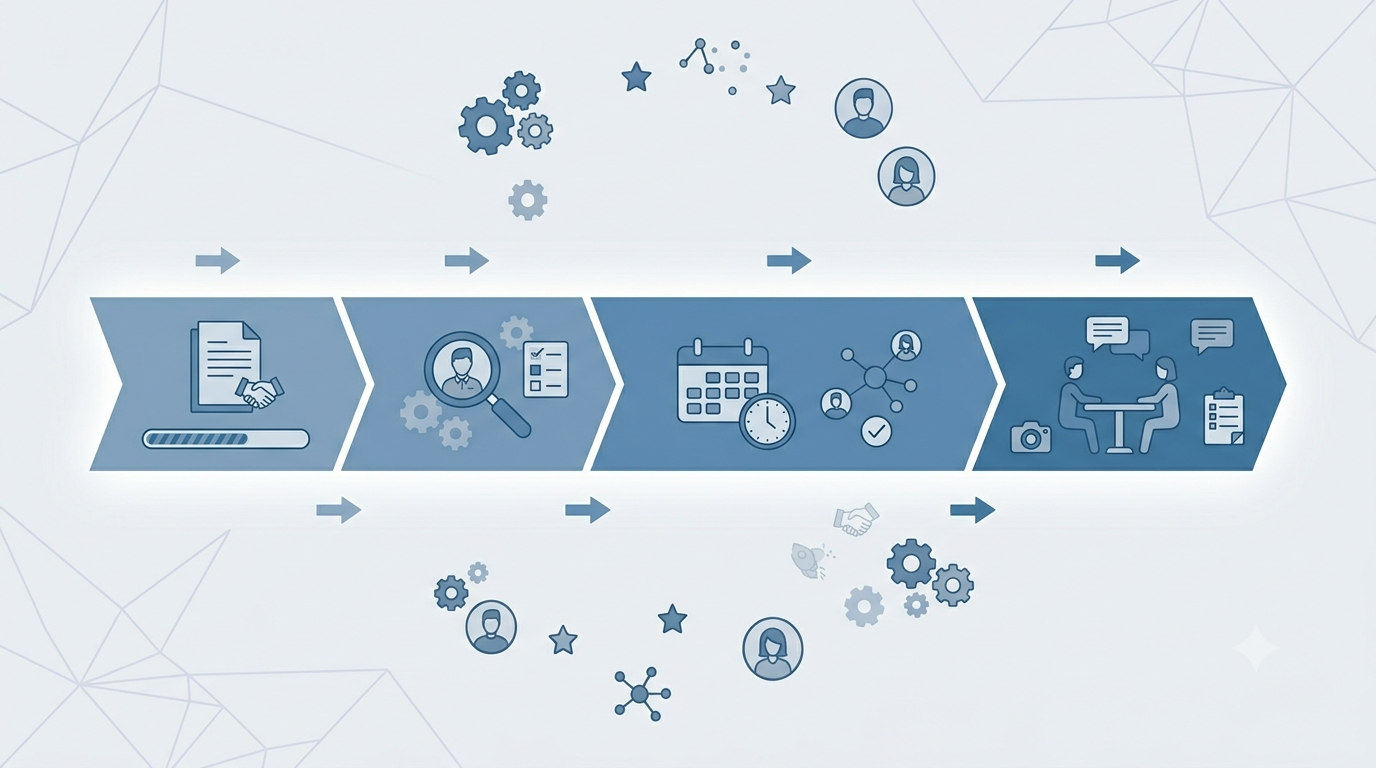
StageTypical TimeWhat's Actually HappeningApplication to acknowledgment3–5 daysCandidate isn't told their application was received; sets early tone for engagementAcknowledgment to screening decisionVaries with volumeRecruiter reviewing volume against role criteriaScreening decision to first interview7–14 days (largest stage)Interviewer calendar coordination, manual scheduling back-and-forthInterview to next-stage decision~11 days (candidate-reported)Feedback collection, panel debrief, internal alignment
Notice that the widest gap in this table — screening decision to first interview — has almost nothing to do with whether the candidate is qualified. It's a coordination problem: finding a mutually available slot, often across multiple interviewers, frequently done through manual email exchanges rather than a shared, real-time scheduling system.
Why the Scheduling Gap Specifically Gets This Wide
1. Multiple Interviewer Calendars Are Being Coordinated Manually
Even a simple two-person panel requires finding a slot that works for the candidate and both interviewers — a three-way coordination problem that grows combinatorially as more interviewers are added, especially when it's handled through back-and-forth email rather than shared availability tools.
2. Interviewers Deprioritize Scheduling Requests Against Their "Real" Work
Because interviewing is usually a secondary responsibility for hiring managers and panel members — layered on top of their primary job — scheduling requests often sit unanswered for days behind higher-priority tasks, widening the exact gap the data identifies as the biggest bottleneck.
3. There's No Shared Visibility Into Where a Candidate Is Stuck
Without a live view of where a specific candidate sits in the process, a recruiter often doesn't notice a scheduling request has gone unanswered for several days until they check in manually — by which point real delay has already accumulated.
4. Rising Interview Volume Compounds the Same Bottleneck
With interview counts per hire increasing meaningfully in recent years, every additional round adds another full scheduling coordination problem on top of the ones before it — compounding, not just adding, delay.
5. Acknowledgment Delay Sets a Bad First Impression Before Scheduling Even Starts
Even though the acknowledgment stage itself is short in absolute days, a candidate who hears nothing for several days after applying starts the relationship with reduced confidence — meaning by the time scheduling begins, some of the candidate's engagement and patience has already been spent.
A Practical Framework: Fixing Each Stage Specifically
Fix 1 — Automate Application Acknowledgment Immediately
A same-day, automated acknowledgment (even a simple "we've received your application and are reviewing it") costs nothing to implement and directly addresses the first, smallest — but earliest — point of candidate uncertainty.
Fix 2 — Compress Screening Decision Time With Structured Criteria
Faster screening doesn't require rushing evaluation — it requires clear, pre-defined criteria (see the "why manual resume screening costs you your best candidates" framework) so a decision can be reached without repeated re-reading or second-guessing.
Fix 3 — Replace Manual Scheduling With Self-Service Booking
Since the screen-to-interview gap is both the widest stage and the one candidates most clearly prefer to have automated, self-service scheduling tools — where a candidate picks from real-time interviewer availability directly — are the single highest-leverage fix available for this specific bottleneck.
Fix 4 — Batch or Parallelize Interview Rounds Where Possible
Where feasible, scheduling multiple interview rounds in a single day (a "super day" format) or running panel interviews instead of sequential one-on-ones compresses total elapsed time even when the number of individual conversations stays the same.
Fix 5 — Give Recruiters Live Visibility Into Stalled Scheduling Requests
Rather than relying on a recruiter to remember to check in, a system that flags when a scheduling request has gone unanswered for a set number of days turns an invisible delay into a visible, actionable one — directly addressing the "no one notices until it's already late" problem.
Fix 6 — Set an Explicit SLA for Interviewer Availability
Pairing this with a broader hiring manager accountability structure — a defined expectation for how quickly interviewers should offer availability once a scheduling request goes out — closes the loop between measuring the delay and actually holding the responsible party accountable for it.
A Practical Checklist: Auditing Your Own Time-to-First-Interview
Measure each stage separately (acknowledgment, screening, scheduling, interview) rather than tracking one blended number
Confirm candidates receive an automated acknowledgment within 24 hours of applying
Check how much of your total pre-interview delay sits specifically in the scheduling gap, not screening
Replace manual scheduling coordination with self-service booking wherever interviewer calendars allow it
Set a clear SLA for how quickly interviewers should provide availability once a scheduling request is sent
Track how many days a scheduling request typically sits unanswered before someone manually follows up
Global Perspective: Time-to-First-Interview Pressures by Region
🇦🇺 Australia
With vacancy fill rates declining to roughly 68.2% nationally (Jobs and Skills Australia, March 2026) and skills shortages concentrated in trades and technical roles, a slow scheduling gap is especially costly in the Australian market — every extra day spent coordinating calendars is a day a thin, already-scarce qualified candidate has to reconsider or accept another opportunity.
🇺🇸 United States
The clearest, most granular stage-by-stage benchmarking data available is U.S.-anchored (Gem, SHRM, GoodTime), consistently showing the scheduling gap — not screening — as the widest single stage in the pre-interview funnel.
🇬🇧 United Kingdom
CIPD data on persistent hard-to-fill vacancies in healthcare, social care, and education suggests UK employers in these sectors face a double pressure: a genuinely thin qualified pool, combined with the same scheduling-coordination bottleneck seen elsewhere, making self-service scheduling and clear SLAs particularly valuable levers.
🇪🇺 Europe (broad view)
Interview process norms and typical panel sizes vary by country, but the underlying mechanism — manual, multi-person calendar coordination as the primary source of delay — is a broadly consistent pattern across European hiring processes as well.
🇮🇳 India
With 82% of Indian employers reporting difficulty filling roles (ManpowerGroup's 2026 Talent Shortage Survey) and fierce competition for scarce technical skills, compressing the scheduling gap specifically is a high-leverage fix — candidates in high-demand technical fields are the most likely to have competing interview processes moving in parallel.
What Most Articles Get Wrong
Most "reduce time-to-hire" content treats the entire pre-offer period as one undifferentiated block of time to compress, without identifying which specific stage is actually responsible for the bulk of the delay. The data is fairly consistent on this point: the scheduling gap between screening and the first interview, driven by interviewer calendar availability, is typically the single largest stage — larger than the initial application-review period most teams instinctively blame.
The second common gap: most guides recommend "communicate more" as a blanket fix, without distinguishing between the acknowledgment stage (where a fast, simple automated message solves the problem almost entirely) and the scheduling stage (where the fix isn't more communication, but a structurally different coordination mechanism — self-service booking rather than manual email).
Common Mistakes Companies Make
❌ Assuming screening time is the biggest bottleneck without measuring each stage separately
❌ Leaving application acknowledgment manual or inconsistent, costing candidate confidence for free
❌ Coordinating multi-person interview panels entirely through manual email back-and-forth
❌ Having no visibility into scheduling requests that have gone unanswered for several days
❌ Adding more interview rounds without accounting for the compounding scheduling burden each one creates
❌ Setting no clear expectation for how quickly interviewers should provide their availability
Checklist: Is Your Time-to-First-Interview Actually Optimized?
You track time-in-stage separately for acknowledgment, screening, and scheduling
Acknowledgment happens automatically, same day
Scheduling uses self-service booking rather than manual coordination wherever possible
You know exactly how many days, on average, a scheduling request sits before an interview is confirmed
Interviewers have a clear SLA for providing availability once a request goes out
Stalled scheduling requests are flagged automatically, not discovered through manual recruiter check-ins
Where Tools Fit — and Where They Don't
Given that the data consistently identifies interviewer scheduling coordination — not candidate evaluation — as the largest single source of delay, this is precisely the stage where the right tooling delivers the clearest, most measurable improvement: automated same-day acknowledgment, self-service scheduling that lets candidates book directly against real interviewer availability, and live visibility into scheduling requests that have stalled. This is exactly the layer FastHire's scheduling and workflow tools are built to address — removing the manual coordination overhead that the data shows is the true bottleneck, rather than simply asking recruiters to screen resumes faster.
What tooling alone can't fix is a hiring manager or interview panel that treats scheduling requests as low priority relative to their other responsibilities — that requires the accountability structure (clear SLAs, visible compliance) discussed in the FastHire piece on hiring manager accountability. The most effective approach pairs automated scheduling infrastructure with genuine organizational commitment to treating interviewer availability as a real, time-bound obligation.
Key Takeaways
Time-to-first-interview is a distinct, highly controllable metric worth tracking separately from broader time-to-fill, since it's where most early candidate disengagement occurs.
Contrary to the common assumption, screening time is rarely the largest bottleneck — the scheduling gap between screening and the first interview, typically 7 to 14 days, consistently shows up as the widest single stage.
This gap is driven primarily by interviewer calendar availability and manual coordination, not by the time needed to evaluate candidates.
A fast, automated acknowledgment addresses the earliest point of candidate uncertainty cheaply and immediately, even though it's a short stage in absolute days.
Self-service scheduling is the single highest-leverage fix for the widest stage, and it's also what a majority of candidates say they prefer over manual email coordination.
Fixing this requires both better tooling and a genuine SLA for interviewer responsiveness — automation alone doesn't work if scheduling requests still sit deprioritized for days.