
Structuring Interview Feedback So Hiring Decisions Aren't Delayed
Rakesh · August 24, 2026 · 17 min read
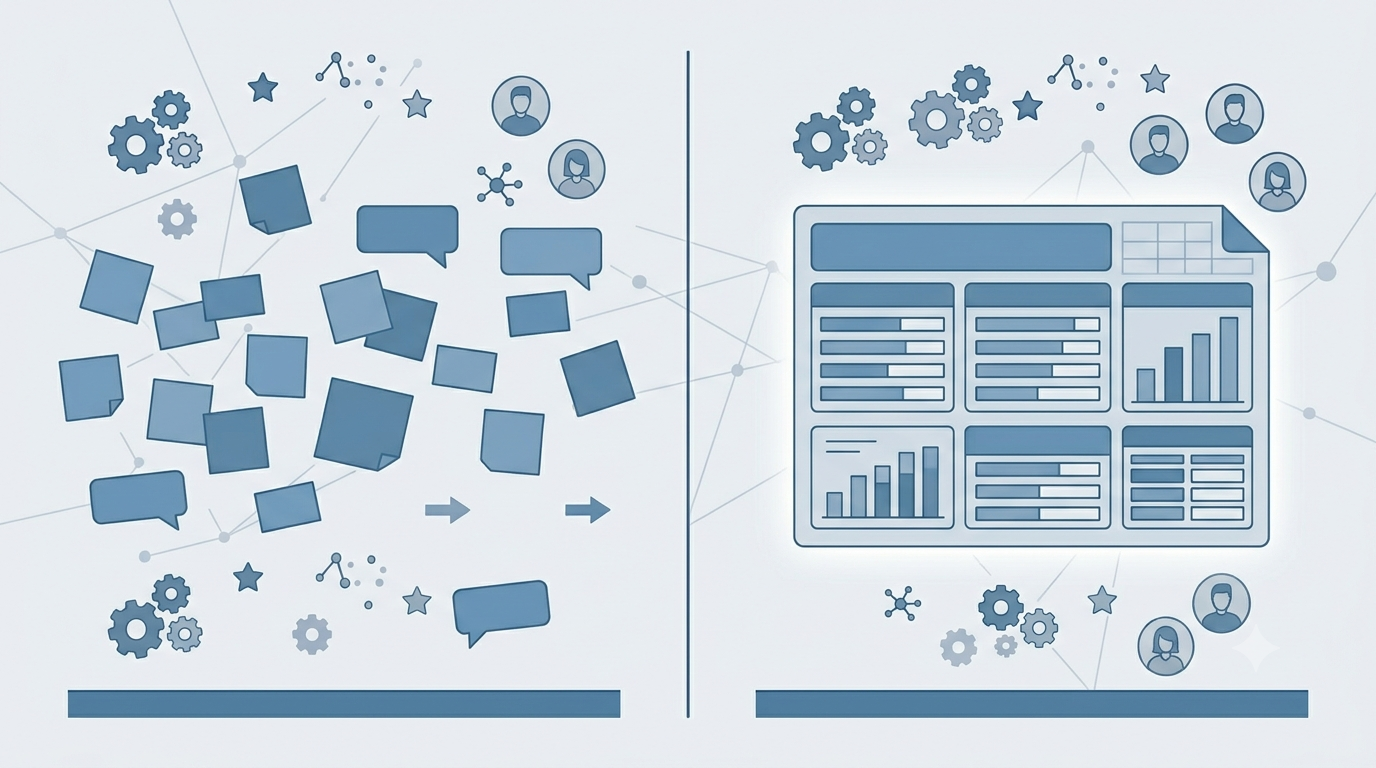
The interviews happened days ago. Everyone seemed positive in the hallway conversation afterward. And yet the hiring decision is still stuck — because one interviewer's feedback lives in a Slack message, another's is a vague verbal impression nobody wrote down, and the debrief meeting keeps getting rescheduled because half the panel hasn't actually submitted anything yet.
This is one of the most common, most fixable bottlenecks in hiring, and it rarely gets the attention it deserves. Most conversations about hiring speed focus on sourcing and scheduling. But a strong candidate who's already made it through your interview process can still be lost entirely at this stage — not because anyone made a bad decision, but because no decision got made in time.
This article lays out why unstructured feedback collection delays hiring decisions, what the research actually says about structured evaluation, and a practical framework for collecting feedback that leads to a fast, defensible decision instead of a stalled one.
Why This Stage Quietly Costs You Candidates
Interview feedback delay doesn't happen in isolation — it compounds directly with everything already working against you in a competitive hiring market. Top candidates typically remain actively available for only around 10 days before a faster-moving competitor closes them. SHRM's 2025 benchmarking data shows that screening and interviewing each already consume roughly 8–9 days on their own — meaning the feedback-and-decision stage that follows has very little runway left before you're at real risk of losing your preferred candidate to someone who decided faster.
Separately, GoodTime's 2025 Hiring Insights Report found that 45% of talent acquisition leaders say more touchpoints are now required in the hiring process than in previous years — more stakeholders, more structured checkpoints, more coordination — which means the feedback-collection burden per requisition has grown, even as recruiter capacity has shrunk. Gem's 2025 Recruiting Benchmarks Report shows the average recruiter is juggling 14 open requisitions simultaneously, up 56% in three years. Chasing five unstructured, undocumented interviewer impressions across a dozen-plus open roles is not a sustainable system — it's a bottleneck waiting to happen on every single requisition.
The reframe worth internalizing: A slow hiring decision doesn't usually mean the decision was hard. It usually means the inputs to the decision were scattered, incomplete, or delayed — and no one had a clear, fast way to assemble them into something the panel could actually act on.
What the Research Actually Says About Structured Interviews
This isn't just a process-efficiency argument — it's also a decision-quality argument, and it's backed by some of the most well-established research in industrial-organizational psychology.
Schmidt and Hunter's landmark 1998 meta-analysis, published in Psychological Bulletin and synthesizing 85 years of personnel-selection research, found that structured interviews have a validity of .51 for predicting job performance, compared to just .38 for unstructured interviews — a substantial gap in how reliably each method actually identifies who will succeed on the job. Combining a structured interview with a general mental ability assessment pushed predictive validity as high as .63, among the strongest combinations of any selection methods studied.
More recent research has, if anything, strengthened the case for structure specifically. A 2022 re-analysis by Sackett, Zhang, Berry, and Lievens, published in the Journal of Applied Psychology, revisited the original meta-analytic estimates with more conservative statistical corrections and found that structured interviews emerged as the single strongest predictor of job performance of all 19 selection methods studied — even ahead of cognitive ability testing, which had previously been considered the top predictor. As the lead researcher put it, this suggests structured interviews deserve to be treated as the benchmark method other approaches are compared against, not simply one input among many.
The practical implication is direct: the same structure that makes feedback collection faster and less chaotic is also the structure that makes your hiring decisions more accurate. This isn't a tradeoff between speed and quality — a well-designed structured process improves both simultaneously.
Why Unstructured Feedback Slows Everything Down
1. There's No Common Format to Aggregate
When one interviewer sends a paragraph in an email, another leaves a voicemail, and a third just says "yeah, I liked them" in the hallway, there's no way to quickly compare inputs across the panel. Someone — usually the recruiter — has to manually translate scattered impressions into something resembling a decision, which takes real time and introduces their own interpretation into the process.
2. Feedback Waits for a Debrief Meeting to Even Get Collected
Without a clear individual deadline, many interviewers default to sharing their thoughts only when the debrief meeting happens — which means the meeting itself becomes the bottleneck, and if even one interviewer is unavailable, the whole decision stalls.
3. Vague Feedback Requires Follow-Up Questions
"They seemed strong" or "I had some reservations" isn't specific enough to act on. Someone has to go back and ask what, specifically, drove that impression — adding another round-trip delay before a real decision can be made.
4. The Loudest Voice, Not the Best Evidence, Often Wins the Debrief
Without individual, evidence-based scores submitted before a group discussion, debrief conversations are vulnerable to anchoring — where the first strong opinion voiced in the room disproportionately shapes everyone else's framing, regardless of what each interviewer actually observed independently.
5. There's No Clear Trigger for "We Have Enough Information to Decide"
Without a structured framework tied to specific competencies, it's often unclear whether the panel is missing a genuinely important signal or simply hasn't finished talking. This ambiguity itself causes delay, since no one wants to make the call prematurely.
A Practical Framework: The Structured Feedback Sequence
Step 1 — Define Competencies Before the Interview, Not After
Every interview loop should map to a small number of specific, job-relevant competencies (typically 6–12, per common structured-interview practice) determined before candidates are ever interviewed — not reverse-engineered from whatever came up in the conversation. Each panel member should know exactly which competency (or competencies) they're responsible for assessing, so their feedback maps directly onto a decision-relevant dimension.
Step 2 — Use a Consistent Rating Scale With Behavioral Anchors
A simple 4- or 5-point scale, with a brief description of what each rating level actually looks like in practice, keeps ratings comparable across interviewers. A "4" from one interviewer should represent roughly the same standard as a "4" from another — which only happens if the scale itself is well-defined in advance.
Step 3 — Require an Evidence Line for Every Rating
A rating without a specific, concrete example behind it is an opinion dressed up as data. Requiring each interviewer to include at least one specific thing the candidate said or did that justified their score keeps feedback traceable, defensible, and genuinely useful to whoever reads it — the hiring manager today, or someone reviewing the decision months later.
Step 4 — Set a Firm, Short Deadline for Individual Submission
Interviewers should submit their scorecard independently — before any group discussion — within a clearly communicated window (commonly within 24 hours of the interview, while the details are still fresh). This does two things: it prevents anchoring bias in the debrief, and it means the debrief can happen as soon as the last scorecard is in, rather than waiting on an open-ended conversation to surface everyone's views for the first time.
Step 5 — Run the Debrief as Synthesis, Not Discovery
If every interviewer has already submitted an independent, evidence-backed score, the debrief meeting becomes a much shorter conversation: comparing existing scores, discussing genuine disagreements, and reaching a decision — rather than a first-time airing of everyone's raw impressions. This is often the single biggest time-saver in the entire sequence.
A Practical Checklist: Removing Feedback-Stage Delay
Competencies and rating scale are defined before the interview loop begins, not after
Each interviewer knows exactly which competency they're responsible for assessing
Scorecards require a specific evidence line for every rating, not just a number
Interviewers submit scorecards independently within a set window (e.g., 24 hours) before any group discussion
The debrief meeting is scheduled to begin as soon as the last scorecard is in, not on a fixed calendar delay
There's a clear, defined process for what happens if a scorecard is late (escalation, reminder, or a defined cutoff)
Global Perspective: Structured Hiring Practices by Region
🇦🇺 Australia
With persistent skills mismatches driving vacancy fill rates down to roughly 68.2% nationally (Jobs and Skills Australia, March 2026), structured, evidence-based interview evaluation is particularly valuable in the Australian market — it helps distinguish genuinely capable candidates from those who simply interview well, in a market where the qualified pool is already thin.
🇺🇸 United States
The most detailed academic research underpinning structured interviewing (Schmidt & Hunter, Sackett et al.) originates largely from U.S.-based industrial-organizational psychology research, and U.S. benchmarking data (SHRM, Gem) provides the clearest picture of how feedback delay compounds with broader time-to-fill pressure.
🇬🇧 United Kingdom
CIPD data showing 41% of UK new hires resigning within their first 12 weeks suggests that decision quality, not just decision speed, matters significantly in this market — a rushed but poorly evidenced decision may fill a role quickly, only for the mismatch to surface within a few months.
🇪🇺 Europe (broad view)
Structured interviewing practices and validity research are well established across European I/O psychology as well, though local labor regulations around hiring documentation (particularly in markets with stronger employee protections) make a clear, evidence-backed decision trail an added practical benefit, not just a nice-to-have.
🇮🇳 India
With 82% of Indian employers reporting difficulty filling roles, per ManpowerGroup's 2026 Talent Shortage Survey, and intense competition for scarce technical skills, a fast, structured feedback process is especially valuable — every extra day spent waiting on a scattered debrief is a day a competing employer can close the same candidate first.
What Most Articles Get Wrong
Most content on interview scorecards focuses entirely on template design — what competencies to include, what scale to use — without addressing the actual mechanism that causes delay: the gap between when an interview happens and when structured feedback about it becomes available for a decision. A beautifully designed scorecard that sits unsubmitted for a week doesn't speed anything up. The deadline and submission discipline matter as much as the template itself.
The second common gap: most guides treat "structured interviewing" as purely a fairness or bias-reduction initiative, without connecting it clearly to the well-established predictive-validity research. The case for structure isn't just "it's more fair" — it's that the research consistently shows it's also more accurate at identifying who will actually succeed in the role, which is a much stronger business case for adopting it than fairness framing alone.
Common Mistakes Companies Make
❌ Letting interviewers share feedback only verbally, with nothing written down until the debrief
❌ Using a scorecard with no behavioral anchors, so a "4" means something different to every interviewer
❌ Allowing group discussion before individual scores are submitted, inviting anchoring bias
❌ Having no clear deadline for feedback submission, so the debrief waits indefinitely on stragglers
❌ Treating the debrief meeting as the place feedback gets discovered, rather than where it gets synthesized
❌ Designing competencies to assess after interviews are already underway, rather than before the loop begins
Checklist: Is Your Feedback Process Actually Structured?
Competencies were defined before candidates were ever interviewed
Every interviewer uses the same rating scale with clear behavioral anchors
Every submitted rating includes a specific evidence line
Scorecards are submitted independently, before any group discussion happens
There's a firm submission deadline, with a defined process for late feedback
Your debrief meetings typically run shorter because most of the real evaluation work already happened beforehand
Where Tools Fit — and Where They Don't
Given how directly feedback delay compounds with recruiter capacity constraints and competitive hiring pressure, this is a stage where the right tooling delivers clear, measurable relief: digital scorecards that enforce a consistent structure and evidence requirement, automated reminders for interviewers who haven't yet submitted feedback, and a system that surfaces the moment a full set of scorecards is ready for debrief — rather than a recruiter manually chasing five different people across five different channels. This is precisely the layer FastHire's structured evaluation tools are designed to support, turning scattered interviewer impressions into a fast, comparable, decision-ready format automatically.
What no tool can fix is a panel that hasn't agreed on what competencies actually matter for the role, or a company culture where feedback deadlines aren't genuinely enforced. Structure has to be designed thoughtfully before it can be automated effectively — the technology accelerates a good process; it doesn't create one from nothing.
Key Takeaways
Interview feedback delay is a distinct, fixable bottleneck — separate from sourcing or scheduling — that can still cost you a strong candidate even after they've made it through your process.
Schmidt and Hunter's landmark meta-analysis found structured interviews substantially outpredict unstructured ones (.51 vs .38 validity); more recent research (Sackett et al., 2022) found structured interviews to be the single strongest predictor of job performance among all methods studied.
Structure isn't a tradeoff against speed — a well-designed structured process improves decision speed and decision accuracy at the same time.
The core fix is sequential: define competencies before interviews happen, use a consistent scale with evidence requirements, collect feedback independently within a firm deadline, then run the debrief as synthesis rather than first-time discovery.
The debrief meeting itself is usually not the bottleneck — the scattered, undocumented feedback that has to be chased down before the debrief can happen is.
Tooling can automate reminders and aggregation, but the underlying structure — competencies, scales, deadlines — has to be designed deliberately first.