
Why Your Candidate Pipeline Keeps Drying Up
Rakesh · August 4, 2026 · 16 min read
You post the job. Applications trickle in. A few look promising. You reach out — and then... nothing. Interviews get scheduled and no-showed. Offers go out and get declined. Three weeks later, you're back where you started: an open req, a stalled pipeline, and a hiring manager asking why this is taking so long.
If that cycle sounds familiar, you're not imagining it, and you're not doing something uniquely wrong. Recruiting teams globally are managing 93% more applications and 40% more open roles than they were in 2021 — with teams that are 14% smaller than they used to be. Hires per recruiter have dropped 43% in that same window, even though hiring volumes have started climbing again. Something in the system is leaking, and it isn't effort.
This article breaks down exactly where candidate pipelines actually fail — not the vague "there's a talent shortage" explanation, but the specific structural, behavioral, and process failures that quietly drain a pipeline dry. Then we'll walk through a practical framework for rebuilding one that doesn't collapse the moment you stop actively pushing it.
What "Candidate Pipeline Drying Up" Actually Means
A candidate pipeline is the pool of people — active applicants, passive prospects, past applicants, referrals — available to move into your hiring process at any given time. When recruiters say a pipeline is "drying up," they usually mean one of three distinct problems, which is important because each has a different fix:
SymptomWhat's Actually HappeningRoot Cause CategoryFew or no applicationsTop-of-funnel sourcing failureVisibility & channel problemApplications come in, but quality is poorScreening or targeting mismatchSourcing precision problemGood candidates enter, then disappearMid-funnel drop-offProcess & communication problemCandidates make it to offer, then decline or ghostLate-stage collapseSpeed, competition & experience problem
Most articles about "fixing your pipeline" jump straight to sourcing tactics. That's a mistake. If you don't know which of these four failure points is actually costing you candidates, you'll pour effort into the wrong stage — sourcing harder into a funnel that's actually leaking at the interview stage, for example.
The Data: This Is a Structural Problem, Not a You Problem
Before diagnosing your own pipeline, it helps to see the macro picture, because it reframes the problem. This isn't a personal failure of sourcing skill — it's an industry-wide shift in how candidates behave and how funnels perform.
Volume is up, but conversion is down. Recruiting teams analyzed across more than 6,000 companies and 640 million applications found that application volume has roughly doubled since 2022, while the number of recruiters managing that volume has been cut nearly in half. On average, it now takes roughly 213 candidates sourced, screened, and processed to produce a single placement across recruiting and search firms — and only about 0.5% of applicants are ultimately hired for a given role.
Ghosting has hit a record high on both sides. Roughly 53% of job seekers report being ghosted by an employer in the past year — a three-year peak, largely attributed to AI-inflated application volume overwhelming hiring teams' ability to respond to everyone individually. Employers feel the same problem in reverse: 41% of organizations say candidates are ghosting them during the interview process, according to SHRM's 2025 Talent Trends report. This is a two-way trust breakdown, and it's compounding — the more employers go silent, the more candidates disengage pre-emptively, and vice versa.
Time is the silent killer of pipelines. Average time-to-fill in the U.S. has stretched to roughly 44 days, up from 33 days in 2021 — a 33% increase. Recruiters are also juggling an average of 14 open requisitions simultaneously, a 56% jump in three years. Every extra day a strong candidate sits in your pipeline is a day a competitor can make them an offer instead.
Top-of-funnel is genuinely the weakest link for most teams. In one industry survey, 68% of companies identified the top of their hiring funnel as their weakest point, largely because they rely primarily on job boards — a channel that, by definition, only reaches people who are already actively looking.
And that's the crux of the problem: most of the workforce isn't actively looking at all. LinkedIn's Talent Trends research, based on tens of thousands of professionals surveyed globally, consistently finds that roughly 70% of the global workforce qualifies as "passive" talent — employed, not browsing job boards, not submitting applications — though about 45% of that group would be open to the right opportunity if a recruiter reached out well. If your entire sourcing strategy is "post and pray," you are, by design, only fishing in the smallest part of the pond.
The uncomfortable truth: A pipeline built entirely on inbound applications was never going to be a deep pipeline. It was only ever going to be a shallow one that happens to refill when the job market is candidate-heavy and dries up the moment it isn't.
The 7 Real Reasons Pipelines Dry Up
1. You're Only Fishing Where Candidates Are Already Looking
Job boards are useful, but they select for a specific population: people who are unemployed, unhappy, or urgently searching. That population moves fast, is shared across every competing job board and every competing employer, and skews toward candidates who are more available because they're less in demand elsewhere.
Meanwhile, the strongest performers in most fields — the ones actually driving your business outcomes if hired — are usually not job-board browsers. They're heads-down doing good work, and the only way to reach them is proactive outreach: sourcing, referrals, alumni networks, and talent communities.
What most articles get wrong here: they tell you to "diversify your channels," which is true but incomplete. The deeper fix is recognizing that active and passive candidates require entirely different value propositions in the first message. An active job seeker responds to "we're hiring." A passive candidate responds to "here's something specific about your work that made me think of this role" — because you're not solving an urgent problem for them, you're interrupting a life that's already fine.
2. Your Screening Criteria Are Filtering Out People Who'd Actually Succeed
A shrinking pipeline sometimes isn't a sourcing problem at all — it's a screening problem disguised as one. Rigid degree requirements, arbitrary years-of-experience cutoffs, and keyword-matching ATS filters routinely eliminate candidates who could do the job well but don't match a template written for a different market.
This is increasingly recognized as a real drag on hiring in every region we researched. In India, for instance, a clear majority of employers are now shifting toward skills-based hiring criteria specifically because rigid degree filters were narrowing viable candidate pools in a market where 82% of employers already report difficulty filling roles. Jobs and Skills Australia data shows a similar dynamic domestically: application volume is often not the constraint — capability alignment is, with some roles receiving over 100 applications within a day, but only a handful genuinely interview-ready.
Practical fix: Audit your last 10 rejected applications against your last 10 accepted-then-successful hires. If the rejected candidates are strikingly similar in capability to the accepted ones, your filter is a keyword filter, not a competence filter.
3. Your Process Is Too Slow for How Fast Good Candidates Move
Strong candidates — active or passive — typically aren't available for long. Industry data consistently shows top talent can be off the market within roughly 10 days to two weeks of becoming available. If your process takes six days just to review an application, and another two weeks to schedule an interview, you're not competing on skill or salary. You're losing on arithmetic.
This is exactly the mechanism behind the well-documented U.S. and Australian data on hiring bottlenecks: reviews happen quickly relative to interviews, but the gap between application review and first interview is where candidates evaporate — either because they accepted another offer or because the silence read as disinterest.
4. Silence Is Doing More Damage Than You Think
Ghosting isn't just a candidate behavior problem — it's frequently caused by the employer first. Data from Greenhouse's Employer Ghosting research shows candidate silence clusters heavily right after specific moments: roughly a quarter of candidates go quiet right after their first recruiter conversation, another substantial share after a hiring manager interview, and more after a take-home assignment or final round.
Here's the mechanism worth understanding: candidates don't usually ghost out of malice. They ghost because nothing happened on your end that required a response. If a recruiter conversation doesn't trigger a next step within a reasonable window, the candidate reasonably assumes they're no longer being considered — and stops investing further attention, often taking a competing offer instead. The "ghosting epidemic" is, in large part, a decision-latency epidemic wearing a candidate-behavior costume.
5. Your Employer Brand Isn't Doing Its Job Before Candidates Ever Apply
By the time most candidates reach out or apply, they've already researched you. Roughly 86% of job seekers check company reviews and ratings before applying, and a Glassdoor rating below roughly 3.3 stars is associated with losing more than half of potential applicants who simply never apply — meaning your pipeline can dry up before a recruiter ever sends a single message.
Employer brand isn't just a "nice to have" layered on top of recruiting — it's a pipeline multiplier. Organizations with a strong employer brand see meaningfully lower cost-per-hire and materially higher volumes of qualified candidates applying, according to LinkedIn Talent Solutions research, because the brand does pre-qualification work before a recruiter is even involved.
6. You're Treating Every Rejected or Silver-Medalist Candidate as a Dead End
Most recruiters source a new pool from scratch for every open role, discarding perfectly good candidates who simply weren't right for the last opening. This is one of the single most overlooked leaks in the entire funnel. Organizations that maintain pre-built pipelines from past applicants, silver medalists, and talent communities are, on average, roughly twice as fast to hire and see roughly three times higher offer acceptance rates, because they're re-engaging people who already know and like the company rather than starting a relationship from zero.
7. Recruiters Are Spread Too Thin to Run a Real Nurture Strategy
This is the honest, unglamorous root cause underneath most of the above: recruiters are managing more requisitions with fewer resources than at almost any point in the past several years — an average of 14 open roles per recruiter, up 56% in three years, with smaller teams than before. Sourcing outreach, personalized follow-up, and pipeline nurture all take time that simply doesn't exist when a recruiter is drowning in reactive screening for a dozen roles at once. This is precisely the gap that AI-assisted sourcing and screening tools — including the kind built into platforms like FastHire — are designed to close: not replacing recruiter judgment, but absorbing the repetitive sourcing, matching, and follow-up load so a recruiter's limited hours go toward the conversations that actually move candidates forward.
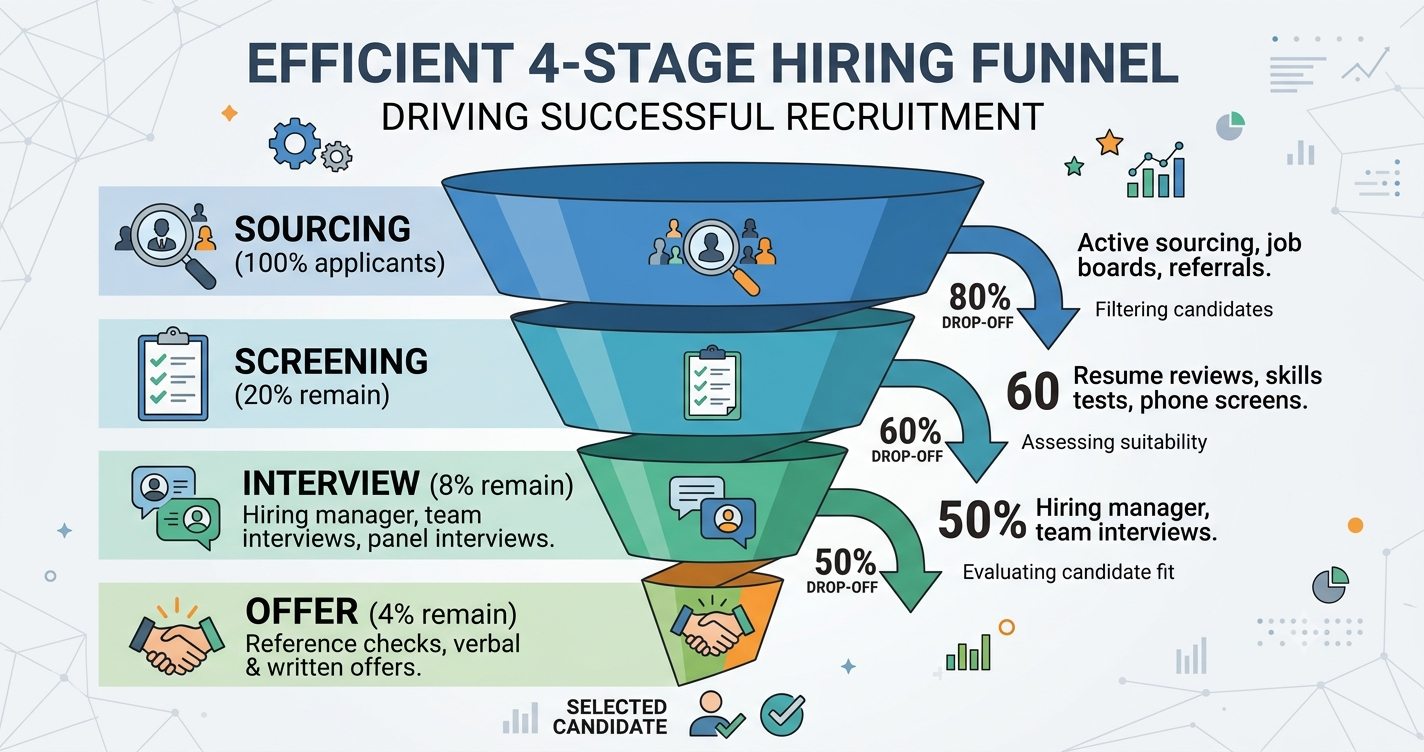
A Simple Framework: The Pipeline Health Diagnostic
Before implementing any fix, diagnose where you're actually leaking. Answer these four questions honestly:
Stage 1 — Top of Funnel: Are you getting enough applications or sourced contacts at all?
If no → you have a visibility problem. Fix: expand channels beyond job boards, invest in proactive sourcing, strengthen employer brand presence where candidates research you.
Stage 2 — Screening: Are the people coming in even remotely qualified?
If no → you have a targeting/filter problem. Fix: audit job descriptions and ATS filters for artificial requirements; consider skills-based screening.
Stage 3 — Mid-Funnel: Do qualified candidates disappear between first contact and final interview?
If yes → you have a speed/communication problem. Fix: compress time-to-first-interview, build in mandatory status touchpoints at every stage, even when there's no update.
Stage 4 — Offer Stage: Do strong candidates decline or ghost after an offer is extended?
If yes → you have a competitiveness/experience problem. Fix: benchmark compensation and process speed against real competitors, tighten the gap between verbal offer and written offer.
Most teams assume their problem is Stage 1 (not enough candidates) when the data more often points to Stage 3 (candidates disappearing mid-process). Diagnose before you spend more budget on sourcing you may not actually need.
Global Perspective: How the Pipeline Problem Differs by Region
Pipeline dynamics aren't identical everywhere. Here's what the data shows across the markets most relevant to global hiring teams.
🇦🇺 Australia
Government labour market data from Jobs and Skills Australia shows the national vacancy fill rate has been declining, falling to roughly 68.2% in the March 2026 quarter, down from 69.1% the prior quarter. Trades and technical roles (Skill Level 3) are hardest hit, with fill rates around 54–55%, and regional Australia consistently lags metropolitan areas by several percentage points. The Australian market is often described as "candidate-heavy but skill-short" — plenty of applications, but a persistent capability mismatch, making screening precision (not just sourcing volume) the priority fix for most Australian teams.
🇺🇸 United States
SHRM's 2025 Talent Trends research puts average U.S. cost-per-hire around $4,700 for non-executive roles, with time-to-fill around 44 days. Candidate ghosting is the #3 recruiting challenge cited by employers, and 69% of employers still report difficulty filling full-time roles despite a cooling labor market. The U.S. story is largely one of volume without conversion: applications are plentiful, but the mid-funnel is leaking badly.
🇬🇧 United Kingdom
CIPD's quarterly Labour Market Outlook consistently shows a large share of UK employers — historically as high as 45–46%, moderating to roughly a third more recently — reporting hard-to-fill vacancies, with healthcare, social care, and education consistently the hardest-hit sectors. CIPD research also found that 27% of UK employers have had new starters simply fail to show up on day one, and 41% have seen new hires resign within the first 12 weeks — evidence that the UK's pipeline problem extends past the offer stage into early retention.
🇪🇺 Europe (broad view)
Patterns across continental Europe largely mirror the UK: persistent shortages concentrated in healthcare, skilled trades, and technology, compounded by demographic aging and, in several markets, immigration policy tightening that has reduced the pool of workers available for lower-paid essential roles.
🇮🇳 India
India shows the most acute shortage figures of any major market studied: ManpowerGroup's 2026 Talent Shortage Survey found 82% of Indian employers report difficulty filling roles — well above the 72% global average — with AI-related skills now the single hardest capability to source, ahead of traditional engineering and IT skills. India's hiring market is also undergoing rapid geographic diversification, with a growing share of hiring shifting to Tier-2 and Tier-3 cities as compensation inflation in metro hubs prices out standard sourcing strategies.
Quick Comparison
RegionBiggest Pipeline ConstraintStandout Data PointAustraliaSkills/capability mismatch54.3% fill rate for trades rolesUnited StatesMid-funnel drop-off & ghosting41% of employers report candidate ghostingUnited KingdomEarly attrition post-hire27% of new hires no-show on day oneEuropeStructural/demographic shortagePersistent healthcare & trades gapsIndiaAcute overall shortage + AI skills82% of employers report hiring difficulty
What Most Articles Get Wrong About Fixing This
Most "how to fix your candidate pipeline" content defaults to a checklist of sourcing channels — post here, try this tool, use this Boolean search string. That advice isn't wrong, but it treats a systems problem as a tactics problem.
The teams that actually fix chronic pipeline drought tend to do three things differently:
They diagnose before they source. They know precisely which stage of the funnel is leaking before spending another dollar on sourcing tools or job board credits.
They build pipeline before they need it. Rather than starting from zero for every requisition, they maintain a living talent community of past applicants, silver medalists, and passive prospects who've opted into being contacted again.
They treat speed as a competitive advantage, not an operational nice-to-have. Every extra day in the process is measured against the real cost of losing a candidate to a faster-moving competitor — not just against internal SLAs.
Common Mistakes Companies Make (Checklist)
❌ Posting the same job description everywhere and hoping volume solves quality
❌ Letting candidates sit for 5+ days without any status update, even a "still reviewing" note
❌ Requiring a degree or years-of-experience cutoff that has no real bearing on job performance
❌ Discarding rejected candidates' data instead of building a re-engagement pipeline
❌ Measuring recruiter success only on requisitions closed, not on pipeline health or candidate experience
❌ Assuming a shrinking pipeline means "we need more applicants" when the real leak is mid-funnel
❌ Ignoring your own employer reviews and Glassdoor presence until it's actively hurting applications
Practical Checklist: Refilling a Dried-Up Pipeline
This week:
Pull your last 90 days of funnel data and identify exactly which stage has the highest drop-off rate
Re-contact your last 20 "close but not quite" candidates from previous roles
Set a hard internal rule: no candidate goes more than 3 business days without an update
This month:
Audit job descriptions for filters that eliminate capable candidates for non-essential reasons
Build (or revive) a talent community list of past applicants who can be re-engaged for new roles
Add one proactive sourcing channel beyond job boards (referrals, alumni networks, niche communities)
This quarter:
Benchmark your time-to-fill and offer-acceptance rate against your specific industry, not a generic average
Review your Glassdoor/employer review presence and respond to outstanding reviews
Evaluate whether an AI-assisted sourcing and screening layer could absorb the repetitive load currently preventing your team from nurturing pipeline consistently
Where Tools Fit — and Where They Don't
It's worth being direct here: technology can meaningfully help with three of the seven leaks above — top-of-funnel visibility, screening precision, and the sheer time cost of manual sourcing and follow-up. AI-powered platforms like FastHire are built specifically to handle that repetitive middle layer: surfacing qualified passive and active candidates from a wider pool than a single job board, applying skills-based screening instead of rigid keyword filters, and automating the status updates that prevent candidates from going quiet mid-process.
What technology can't fix is a genuinely uncompetitive offer, a broken interview experience, or a company culture candidates have already read bad reviews about. No tool replaces the judgment call of which candidates are worth pursuing, or the human conversation that closes a hesitant offer. The realistic view is that the best pipelines combine proactive, AI-assisted sourcing with recruiters who have the time — because the tooling freed it up — to actually build relationships with the people in that pipeline.
Key Takeaways
A "drying up" pipeline is almost never one single problem — it's usually a leak at one specific, identifiable stage (sourcing, screening, mid-funnel, or offer).
Roughly 70% of the workforce is passive and simply won't appear through job-board-only sourcing.
Ghosting is frequently a downstream symptom of slow employer response, not just candidate behavior.
Pre-built pipelines from past applicants convert roughly 2x faster and see roughly 3x higher offer acceptance.
Regional context matters — Australia's problem is largely skills mismatch, the U.S. and UK's is largely mid-funnel drop-off and early attrition, India's is acute overall scarcity.
Fix the leak you actually have. Diagnose before you source harder.