
Understanding Candidate Match Tiers and AI Reasoning
Rakesh · August 5, 2026 · 4 min read
Every sourced candidate carries three things worth understanding at a glance: a match tier (Top, Good, or Possible Match), a relevance score, and a short AI-written explanation of why they scored the way they did. This article covers how to read them — for how the underlying score is actually calculated, see "How FastHire's AI Sourcing Agent Finds and Scores Candidates."
Where to find them
Open any search's results and select a candidate to open their detail panel, or scan the results list/table directly — both show the tier badge and relevance score inline.
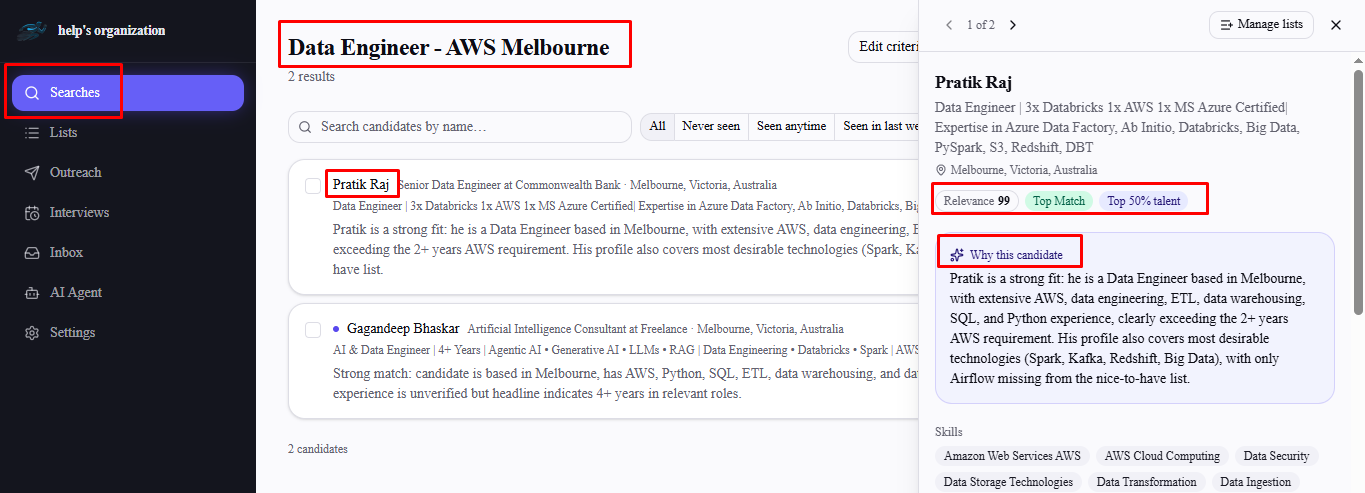
The three match tiers
Top Match (score 75+) — strong fit across the criteria that matter most for this search.
Good Match (score 50–74) — solid fit with some gaps worth a closer look.
Possible Match (score below 50) — worth a look, but with meaningful gaps, or a mandatory criterion the candidate didn't clearly meet.
A useful shortcut: if you're short on time, work Top Match first. If you're trying to fill a hard-to-source role, don't dismiss Possible Match outright — some land there purely because a single mandatory criterion caps the score, not because they're a weak candidate overall.
The Relevance score
The number next to "Relevance" is the same 0–100 score that determines the tier — it's a single weighted figure combining skills, experience, location, education, and company fit against your search criteria. Hover it in the app for a reminder of what it's weighing.
"Top X% talent" badges
Some candidates carry a "Top X% talent" badge (e.g. "Top 5% talent"). This is a relative ranking within this specific search's results — it's not a global benchmark against all LinkedIn profiles or the broader talent market. A candidate ranked highly in a small, narrow search and one ranked highly in a large, broad search aren't being compared to the same pool. Candidates in the bottom half of a search's results never get this badge at all, regardless of their raw score.
"Why this candidate" — the AI's reasoning
Below the score, the "Why this candidate" box holds a short, candidate-specific explanation — one or two sentences naming whichever factors most helped or hurt their score. This is written fresh for each candidate rather than a generic template, so two Top Matches can have quite different reasoning depending on what stood out about each of them.
There's no separate breakdown of the individual scoring dimensions (skills, experience, location, etc.) shown per candidate — the reasoning text is the way FastHire surfaces which dimensions mattered, in plain language rather than a numeric table.
Frequently asked questions
Why is a candidate stuck at Possible Match despite strong reasoning?
Check whether they're missing a mandatory criterion — that alone caps the score at 40 (Possible Match) regardless of how strong everything else is. The reasoning text usually calls this out directly.
Can I sort or filter by match tier?
Yes — the results table and browser both support filtering by tier, so you can focus on Top Match (or any tier) without scrolling past the rest.
Does the percentile badge change if I re-run the agent?
Yes — it's recalculated from that search's current result set each time results are viewed, so adding or removing candidates from the search can shift who qualifies for a badge.
Is the match score the same as how well they'd perform in the role?
No — it's a fit-to-criteria score based on what you've told FastHire matters for this search, not a prediction of job performance. It's only as good as the criteria and calibration behind it.